Success Stories

Men’s Premium Fashion Brand

Men’s Premium Fashion Brand
+179%
Conversion value, YoY
8.26
Peak ROAS (+22% YoY)
+190%
Gross profit, YoY

A full-funnel growth story for peak trading

We partnered with a men’s premium fashion brand to grow profitably through the peak Black Friday and Cyber Monday trading period. The brief wasn’t to win a single channel. It was to build a full-funnel system that could generate early demand, put the brand in front of the right audiences, capture intent at peak, and grow the whole business, not just last-click return. 

Rather than judging success on last-click ROAS alone, we measured the account on the metrics that reflect real commercial health: MER, profit and customer quality. 

The Peak-Trading Problem

Black Friday and Cyber Monday are the most competitive weeks in the retail calendar. Consumer demand rises sharply, but so does competition, and that pushes media costs up at exactly the moment every brand is bidding hardest. 

Creating buying intent at peak means paying peak prices for it. For a creative-led premium brand, where customers rarely convert on their first exposure, leaning only on bottom-of-funnel activity risks overpaying for demand that could have been built earlier, and more cheaply. 

The real challenge was to scale volume, efficiency and profit at the same time, during the year’s most expensive auction. 


A Full-Funnel Game Plan

Ahead of peak, we launched Demand Gen campaigns to create demand before the auction heated up, warming audiences so intent existed before CPCs spiked. 

Paid Social and Demand Gen carried the brand message to new audiences, building the recall a creative-led brand relies on. 

Google Ads captured that demand efficiently as it converted into searches, keeping acquisition costs low. 

CRM converted warm, engaged audiences, turning attention into revenue and repeat purchases. 

Throughout, we read performance across the entire system, MER, profit and customer quality, rather than crediting the last click. 

The Pre-Heat Effect

The pre-heat phase was where the strategy proved itself. 

By creating demand before peak, we saw an immediate uplift in branded search clicks while CPCs fell. By the time Black Friday arrived, brand demand had surged, brand search CPC had dropped as low as £0.05, and conversion rate improved alongside rising volume. 

This is textbook full-funnel behaviour: users see the message, remember the brand, search later with high intent, and convert cheaply. The Demand Gen activity drove hundreds of view-through conversions, users who were exposed to the creative and later purchased through higher-intent channels. 

For a creative-led premium brand, this is exactly how buyers behave. They don’t always click straight away, but strong creative drives recall that later shows up in branded search and organic traffic. 

+179%

Conversion value, YoY

8.26

Peak ROAS (+22% YoY)

£0.05

Brand search CPC at peak

The Results

During the Black Friday to Cyber Monday window, the account scaled hard without giving up margin: 

  • Conversion value up 179% year on year 
  • Gross profit up 190% year on year 
  • Conversions up 176% year on year 
  • ROAS of 8.26, up 22% year on year 
  • AOV held year on year

Across the wider peak period the same pattern held. Google Ads revenue grew 154% year on year, conversion value grew 152%, and ROAS improved 27% to 8.88, all while AOV stayed flat. Revenue and conversions grew faster than investment, and efficiency improved year on year, a sign the account was structured better and had more room to scale. 


The Full-Funnel View

Stepping outside single-platform reporting and into blended attribution told the real story. 

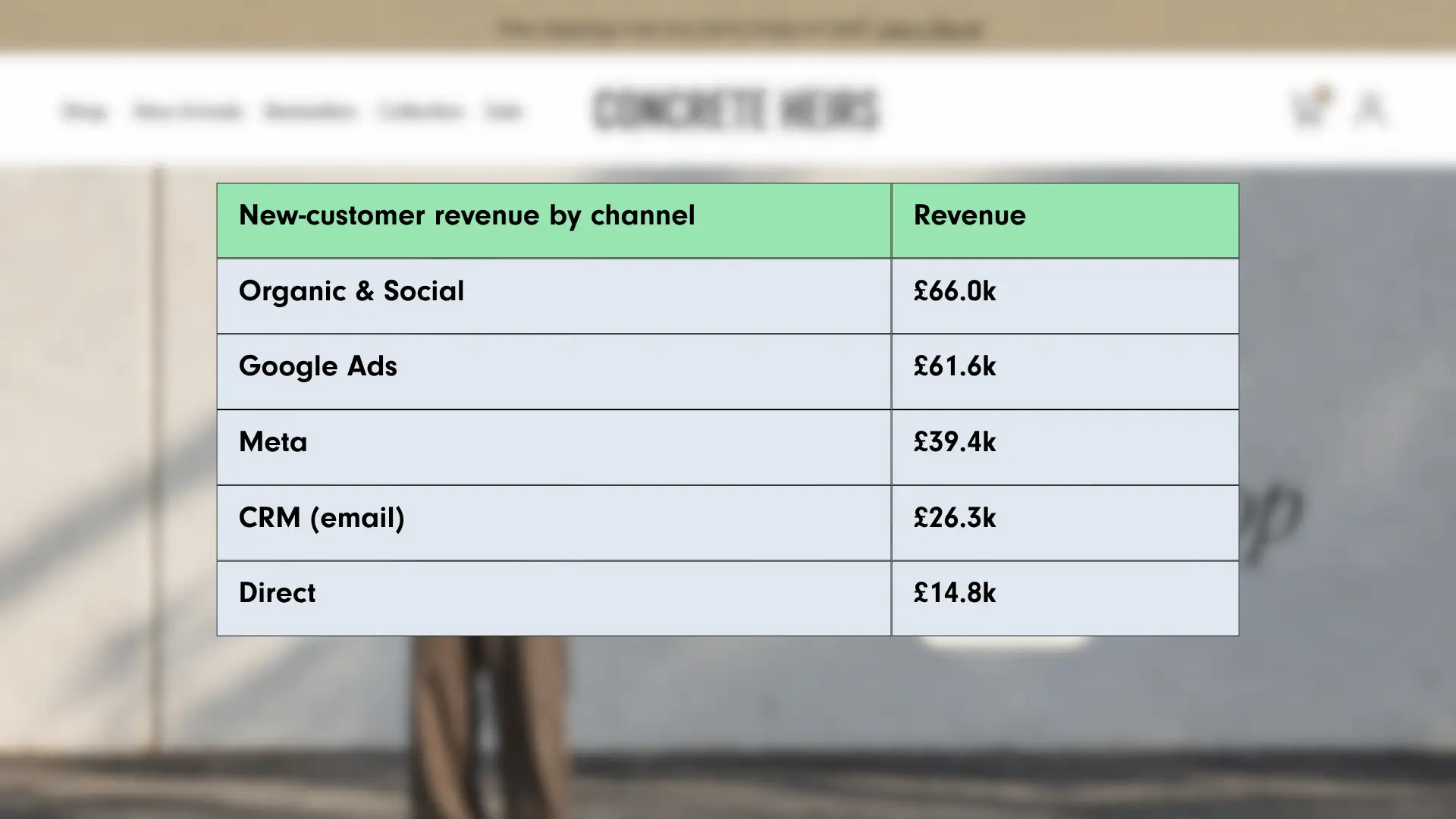
Across the peak window, Google Ads delivered £145.2k in revenue at a 15.68 ROAS, including £61.6k of new-customer revenue at a 6.66 new-customer ROAS. Set against the other channels, Google Ads was the most efficient paid route for converting genuinely new demand. 


On new-customer efficiency, Google Ads led all paid channels with a 6.66 new-customer ROAS, against 2.34 for Meta. 

Most importantly, at a business level the account delivered a blended MER of 8.99. Despite significantly higher investment, blended performance strengthened year on year, proof that optimising the system as a whole beat chasing last-click efficiency. 


What Made the Difference 

The result came from treating the funnel as one connected system rather than a set of separate channels. 

Pre-heating demand before peak meant we weren’t paying top prices to create intent at the worst possible moment. Letting each channel play its natural role, social and Demand Gen for recall, Google for capture, CRM for conversion, kept acquisition efficient. And measuring on MER and profit, not last-click ROAS, kept every decision pointed at business growth rather than channel vanity. 


Final Thoughts 

We delivered a peak-trading campaign that grew revenue, profit and new customers at the same time, during the most competitive weeks of the year. 

Why did it work? 

Because we optimised the whole system, not one channel. Demand was built early and captured cheaply, new customers were acquired profitably, AOV held through heavy promotion, and CRM added meaningful revenue on top. The full-funnel approach didn’t just lift one channel’s ROAS. It made the entire business more efficient. 

Ready to scale your ecommerce brand?

Share your goals with us and discover how our performance-driven marketing strategies can help you grow faster and smarter. 

Proudly part of the PushON Commerce Group

| |